Winter rodent exclusion and trapping relies on structural defense rather than broadcast poisoning. In Northern Minnesota, sub-zero temperatures send field mice and deer mice searching for heated building perimeters by…
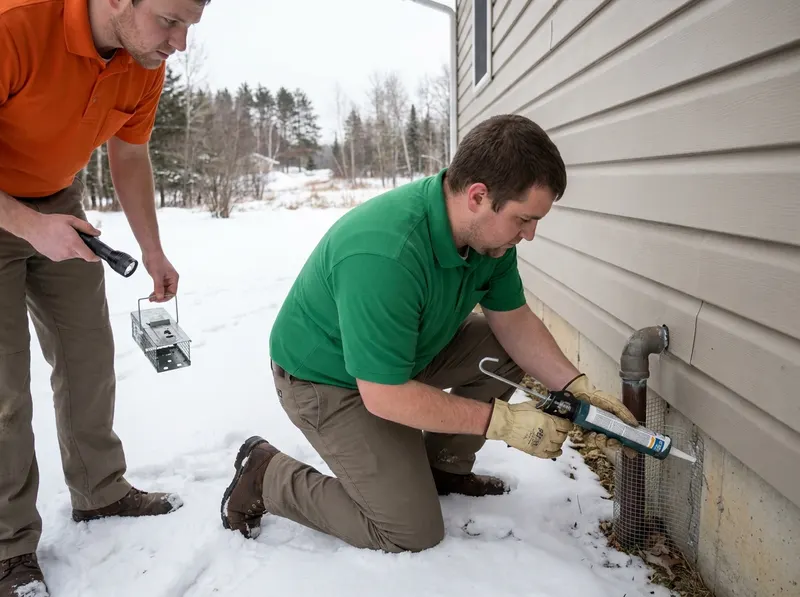
Winter rodent exclusion and trapping relies on structural defense rather than broadcast poisoning. In Northern Minnesota, sub-zero temperatures send field mice and deer mice searching for heated building perimeters by October. The service installs 1/4-inch galvanized hardware cloth over crawlspace vents, fills sill-plate mortar voids, and seals exterior utility penetrations where seasonal pipes enter foundations. This mechanical approach seals entry points as small as one-quarter inch, preventing interior attic nesting while keeping bait products out of the food web around Lake Bemidji. Interior management utilizes localized snap and mechanical capture traps placed strictly along foundational travel paths, checking and resetting them until zero activity registers on interior baseline monitors.
Property construction dictates whether an exterior barrier job or an intensive crawlspace cleanout is required. For traditional lake cabins near the Lake Bemidji North Shore and Birchmont, exposed post-and-pier foundations and lakeside deck junctures offer unmonitored access beneath floors; these structures require perimeter skirting reinforcement and rim-joist sealing. In established residential zones like Nymore, Downtown Bemidji, and Southview Terrace, poured-concrete basements and block foundations typically shift around old dryer vents, bulkhead doors, or water lines, requiring targeted copper mesh and high-density polyurethane packing. While simple trapping reduces the immediate active population within 72 hours, it does not prevent secondary mice from tracking existing pheromone trails into unprotected rim joists; sealing the exterior envelope solves the recurring vector.
Work proceeds through three systematic steps. Step 1: Technicians complete a full 360-degree foundation inspection, mapping foundation cracks, crawlspace crawl-ins, and garage door weatherstripping wear. Step 2: Critical access routes are blocked using gnaw-proof metals, while localized, unexposed trapping systems deploy inside mechanical rooms, basements, and drop ceilings. Step 3: Traps are inspected, cleared, and reset after 7 to 10 days, concluding with a final air-tight check of all patched exterior joints before winter snow accumulations cover perimeter vents.
Every job gets a firm, written price after a free on-site visit.
Tell us about your winter rodent exclusion and trapping job in Bemidji and we'll send a clear, written quote, usually the same day.
 Velzora Pest Control